
CYBERSECURITY KNOWLEDGE HUB
Expert Insights on Penetration Testing & Security
Stay ahead of the curve in a rapidly evolving threat landscape. Here, our certified pentesters share the latest attack vectors, regulatory updates (NIS2, DORA), and defensive strategies.
This is your go-to resource for mastering penetration testing, understanding vulnerabilities, and securing your digital assets against modern cybercriminals.

What Is Penetration Testing? A Guide for Buyers
Penetration testing (pentesting) is an authorized, manual simulation of a real cyberattack on your applications, networks or cloud, in which ethical hackers exploit weaknesses to prove their impact and then deliver a report with step-by-step fixes. A typical pentest...

Purple Teaming: How It Works, Core Roles and Key Benefits
Purple teaming is a collaborative security exercise in which offensive testers (the red team) and your own defenders (the blue team) work together openly to run real attack techniques, check what gets detected and fix what doesn't. Instead of a covert attack and a...

What Is a vCISO? Key Functions and Why Companies Use One
A vCISO is an outsourced security leader who sets strategy, manages cyber risk and guides compliance part-time. Key functions, benefits and cost.

Secure Code Review: What It Checks and Best Practices
Secure code review "is the process of manually examining source code to identify security vulnerabilities that automated tools often miss," according to the OWASP Secure Code Review Cheat Sheet. You'll also see it called a source code review or security code review....

White Box Penetration Testing: How It Works, Benefits and Drawbacks
White box penetration testing (also called clear box, glass box or crystal box testing) is an authorized security test in which testers get full internal knowledge of the target: source code, architecture, network diagrams and privileged credentials. PCI SSC guidance...

Penetration Testing Steps: The Core Phases and Methods
Penetration testing steps: planning and reconnaissance, scanning, vulnerability assessment, exploitation, post-exploitation, cleanup and reporting, plus black, white and grey box methods.

Penetration Test Results: Key Components and How to Evaluate Them
What penetration test results contain, how CVSS severity ratings work, and how to evaluate findings: fix critical risks first, find root causes, then retest.

Automated Penetration Testing: How It Works vs Manual Testing
Automated penetration testing uses software to map your systems, check them for known vulnerabilities and, on some platforms, attempt safe exploitation without a human driving each step. It runs faster and more often than a manual test. But it mostly finds what its...

Physical Penetration Testing: Objectives, Tactics, Process
A physical penetration test is an authorized, simulated break-in where testers try to get past a facility's barriers, access controls and staff to reach areas or systems they shouldn't. It shows whether the controls protecting your buildings hold up against a...
Types of Penetration Testing: Target Domains and Approaches
The main types of penetration testing are network (external and internal), web application and API, mobile, cloud, wireless, social engineering and AI testing, each run as a black, grey or white box test. A penetration test is an authorized, simulated attack that...

Penetration Testing Rules of Engagement: 7 Things to Agree
Penetration testing rules of engagement (ROE) are the written terms that set how a test runs: who authorizes it, when it happens, which techniques are allowed, who hears about urgent findings, when testing stops and what happens to data. NIST calls them "detailed...

Black Box Penetration Testing: How It Works, Pros and Cons
Black box penetration testing starts with no prior knowledge of your systems; here’s how it compares with grey and white box testing in steps, tester-days and typical fit.

Does HIPAA Require Penetration Testing? Current Rules vs. the Proposal
The HIPAA Security Rule never names penetration testing but requires a risk analysis and periodic evaluation, and HHS’s 2025 proposal for annual pentests isn’t binding yet.

Red Team vs Penetration Testing: Which One Do You Need?
The difference in red team vs penetration testing comes down to the question each one answers: a pentest finds which weaknesses in a defined scope can be exploited, while a red team tests whether your defenders can stop a goal-driven attack. Both test your security,...

Does GDPR Require Penetration Testing? Article 32 Explained
No. Article 32 of GDPR never names penetration testing, a test method or a fixed interval. Article 32(1)(d) of Regulation (EU) 2016/679 lists, as appropriate, "a process for regularly testing, assessing and evaluating the effectiveness of technical and organisational...

API Penetration Testing Checklist: What an API Test Should Cover
An API penetration testing checklist should cover your endpoint inventory, authentication, object- and function-level authorization, data exposure, rate limits, business flows, input handling, configuration and evidence for every finding. Mapped to the OWASP API...

Penetration Testing Frequency: How Often Should You Test?
Penetration testing frequency should be at least once a year and after any significant change, with each test typically taking 1 to 3 weeks plus a few days for the report. Risk, regulation and release pace decide whether you need more. Last updated: November 11, 2026...

Penetration Testing Checklist: What to Do Before, During and After the Test
A penetration testing checklist covers five phases: pre-engagement and scoping, reconnaissance and vulnerability analysis, exploitation, cleanup, and reporting with remediation. Before testing, your team signs off the scope and prepares test accounts and backups....

Internal vs External Penetration Testing: Key Differences and Which to Run First
Internal vs external penetration testing comes down to where the attacker starts: an external test begins on the public internet with no access, while an internal test begins inside your network with a standard user account and measures how far that foothold spreads....

Penetration Testing Requirements: Frameworks and Operations
Penetration testing requirements depend on your industry, regulations and security frameworks: PCI DSS v4.0.1 (Requirement 11.4) and DORA name penetration testing, while the other frameworks ask you to test or evaluate your security measures. A compliance penetration...

Penetration Test Scope: What Vendors Ask Before They Quote
A penetration test scope defines what gets tested, how it's tested and what stays off-limits: the target systems, the testing approach, the rules of engagement and the exclusions. Under PCI SSC guidance, "All penetration testing should only be conducted as defined by...

Low-Cost Penetration Testing: How to Cut the Price Without Buying a Scan
Low-cost penetration testing without buying a scan: narrow the scope, prepare test accounts and compare tester-days. Manual web app and API tests from $2,500.

What Are Typical Penetration Testing Rates?
Penetration testing rates explained: US market rates of $850 to $2,500 per tester-day, fixed prices from $2,500 and what pushes a rate up.

How long does a penetration test take?
A typical manual penetration test takes 1 to 3 weeks of testing plus a few days for the report, and scope, tester-days and testing windows decide where yours lands.
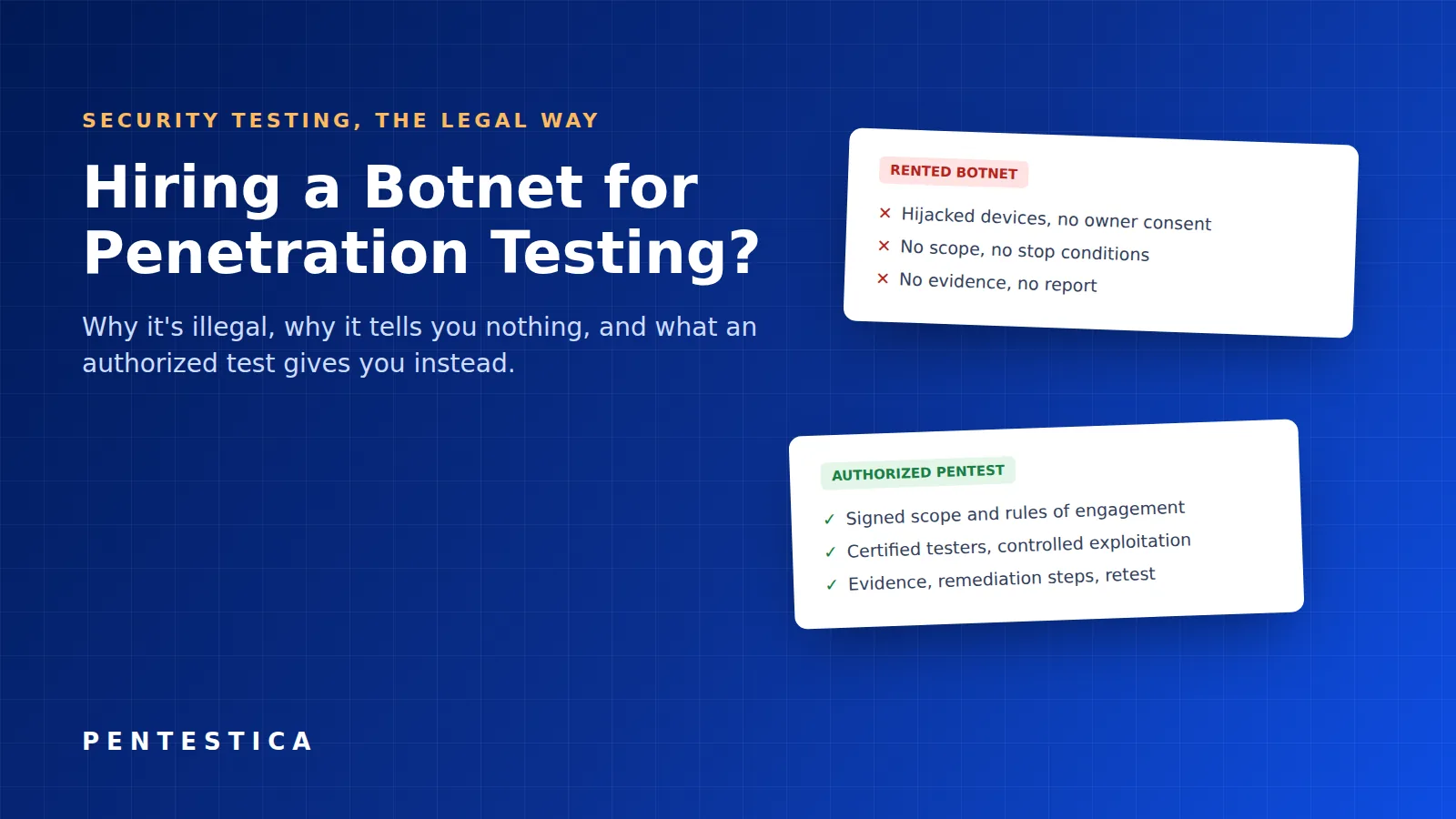
Can You Hire a Dark-Web Botnet for Penetration Testing? Why It’s Illegal and What to Do Instead
No. You can't legally hire a dark-web botnet to test your own systems, and it wouldn't tell you much anyway. A botnet runs on devices whose owners never agreed to lend them, so using one can amount to offenses under the national laws that implement EU Directive...

Penetration Testing in Dubai and the UAE: 2026 Rules, Costs and How to Choose a Provider
Penetration testing rules in Dubai and the UAE depend on who you are. Dubai Government entities, and anyone accessing their information or systems, follow the DESC Information Security Regulation, and penetration tests for Dubai Government entities must come from a...
Penetration Testing vs. Vulnerability Scanning: What’s the Difference?
Security teams often use these two terms interchangeably, leading to dangerous misconceptions. The most common confusion? Thinking that an automated vulnerability scan is the same as a professional penetration test. They are not. A vulnerability scan is software that...