
Advisory & programsCybersecurity consulting
Cybersecurity Consulting From an Offensive Security Team
Pentestica’s cybersecurity consulting is delivered by senior penetration testers who turn real test findings into security strategy, risk assessments and tabletop exercises.
Key facts
- Price
- Quoted individually
- Team
- 10+ years of offensive security
- Covers
- vCISO, tabletop exercises, risk assessment, IT security audit
- Contract
- NDA on request · professional indemnity insurance
Priced in tester-days NDA on request Certified senior pentesters How an engagement works See our report format
Pentestica’s consulting is delivered by senior penetration testers who turn what they find in real penetration tests into security strategy, risk assessments, tabletop exercises and architecture reviews your team can act on.
What our consulting covers
- Threat modeling, architecture and vendor reviews
Scope, tester-days and a fixed price agreed in writing before work starts. Scoped and quoted per engagement. Priced in tester-days, no hidden fees.
Cybersecurity consulting services are independent advisory engagements in which an outside specialist assesses how your organization manages cyber risk and tells you, in priority order, what to fix, build or test next. Pentestica provides cybersecurity consulting, vCISO support, tabletop exercises, risk and maturity assessments, technical security audits, threat modeling and vendor due diligence for companies that want security advice grounded in how attackers actually get in.
Consulting comes from the same offensive security team that has run 500+ penetration tests: 25 certified senior pentesters whose certifications include OSCP, OSCE and CISSP, as well as CEH, CISA, CISM and CRISC across the team. So recommendations are ranked by the attack paths we see in real tests, not by how a control looks on a checklist. We sign an NDA before any work starts, and we carry professional indemnity insurance.
Last updated: October 28, 2026
Key takeaways
- Six consulting services under one roof: vCISO, tabletop exercises, risk and maturity assessment, technical IT security audit, threat modeling with architecture review, and vendor risk with cyber due diligence.
- We don’t certify compliance, run a SOC or MDR, or handle incident response and forensics.
- Every engagement is quoted individually, in tester-days.
- A penetration test can validate the technical recommendations, and a retest is available after fixes.
Advice from attackers
Recommendations ranked by the attack paths we see in 500+ penetration tests.
Six consulting services
vCISO, tabletop, risk assessment, technical audit, threat modeling, vendor due diligence.
Clear boundaries
No compliance certification, SOC, MDR or incident response. We say so up front.
Quoted individually
Scope and tester-days agreed on a scoping call, fixed price in writing.
What does a cybersecurity consultant do?
A cybersecurity consultant assesses your security posture, identifies the risks that matter most to the business and recommends how to reduce them, then helps turn those recommendations into a plan your team can run. The work sits between strategy and engineering.
It answers four questions:
- Where are we exposed, and which exposure would hurt the business most?
- What should we fix first, and who owns each fix?
- Do our controls work in practice, or only on paper?
- What will customers, auditors and regulators ask us to show?
Choosing a consulting provider deserves care. Recital 86 of the NIS2 Directive notes that managed security service providers in areas such as penetration testing, security audits and consultancy “play a particularly important role” in helping entities prevent, detect, respond to or recover from incidents, and that essential and important entities “should therefore exercise increased diligence” in selecting one (Directive (EU) 2022/2555, Recital 86). Recitals explain the Directive; they don’t create obligations on their own.
Know what question you need answered?
Send us the question, the scope and your deadline. You get a written scope, the number of tester-days and a fixed price before work starts. Planning a test as well? See our penetration testing prices.
Which cybersecurity consulting services does Pentestica offer?
Each service runs on its own or as part of a wider program, delivered by the team that runs our penetration tests.
vCISO and security program leadership
A fractional CISO for companies that need security leadership without a full-time hire: a security roadmap, policies, and reporting to the board and to customers.
Tabletop exercises
A facilitated, discussion-based exercise in which leadership and technical teams walk through a realistic attack scenario and test who decides what, when and with which information. It rehearses your response plan; it isn’t incident response.
Cyber risk and maturity assessment
A structured review of how you identify, manage and monitor cyber risk, aligned with the framework you already report against, such as ISO/IEC 27001 or the NIST Cybersecurity Framework, and turned into a prioritized roadmap. It’s an assessment, not a certification or a formal audit.
Technical IT security audit
A hands-on review of configuration and technical controls in systems such as Active Directory, cloud accounts and firewalls. It’s a technical audit, not a certification audit: you get evidence and recommended fixes, not a certificate.
Threat modeling and security architecture review
A review of a system’s design: data flows, trust boundaries, authentication and authorization models, and where an attacker would start. Design issues are easier to change before code ships.
Vendor risk assessment and cyber due diligence
An independent look at the security of a supplier you depend on or a company you plan to acquire: questionnaire and evidence review and, where the supplier or target company authorizes it, technical testing of its exposed systems.
Why get security advice from a penetration testing team?
Because a checklist shows whether a control exists, not whether an attacker can get around it. Clients often expect their biggest risk to be a known technical vulnerability. In our penetration tests, the most interesting findings can instead sit in application logic, in permissions, or in the way several correctly working features interact. A maturity score can look healthy while a path like that stays open.
We’ve also seen the limit of quick fixes. Simple issues can be fixed while a test is still running, but problems in architecture, the authorization model or cloud permissions usually need bigger changes and another retest. Consulting decides which of those changes to make, in what order, and how to prove they worked.
So every technical recommendation we make is tied to an attack scenario, an owner and a way to verify it, often a targeted engagement from our penetration testing services once the fix is in.
Consulting vs penetration testing vs security monitoring: which do you need?
Consulting decides what to do, penetration testing proves what an attacker can do today, and a SOC or MDR provider watches and responds around the clock. Pentestica offers the first two.
| Cybersecurity consulting | Penetration testing | Security monitoring (SOC, MDR) | |
|---|---|---|---|
| Main question | What should we fix, build or test, and in what order? | Can an attacker get in, and how far? | Is someone watching and responding right now? |
| Typical output | Risk register, roadmap, architecture or exercise findings | Report with proven findings, evidence and remediation steps | Alerts, monitoring and incident handling |
| Offered by Pentestica | Yes | Yes | No |
Know the boundaries before you choose. We don’t run a SOC or MDR, and we don’t provide incident response, digital forensics or threat intelligence; an active incident needs a dedicated response provider. We don’t certify compliance either: an assessment or audit from us is evidence for your own auditor, not a certificate. What we can do is help you rehearse your response in a tabletop exercise, and test detection and response in practice through threat-led penetration testing.
How does a cybersecurity consulting engagement run?
1. Scoping call
We agree on the question, the systems, teams and documents in scope, constraints and your contact person. After the call, you get a written scope and a quote in tester-days.
2. Discovery
Interviews, document and configuration review, and hands-on checks where the scope allows. If we confirm a critical issue, we tell your contact during the engagement instead of waiting for the report.
3. Analysis against attack paths
Findings are weighed by how an attacker could chain them, based on what we see in penetration tests, not only by how far a control falls short of a framework.
4. Report and roadmap
Two layers, like our pentest reports: key risks and business consequences for decision-makers, then technical detail your IT team can act on.
5. Validation
A targeted penetration test can confirm fixes hold. A retest is available after fixes; whether it’s included is agreed in the quote.
How much do cybersecurity consulting services cost?
Every consulting engagement is quoted individually, in tester-days, after a scoping call. The price is fixed before work starts, with no hidden fees.
Penetration tests have published prices, from $2,500 for a standard web application or API test. See our penetration testing prices for every test type.
What you receive
- A written report with an executive summary and a technical section, in the same two-layer format as our sample penetration test report.
- A prioritized roadmap: each item with an owner, a priority and a way to verify it.
- For tabletop exercises and vendor reviews: the scenario or target, what we found and what to decide next.
When should you hire a cybersecurity consultant?
Hire one when a security decision is bigger than your team’s time or experience.
No security leader yet
Nobody owns security full time and decisions land on the CTO by default. A vCISO gives you ownership and a roadmap.
A customer sent a security questionnaire
Enterprise buyers want evidence. Consulting helps you answer honestly and plan the tests that back up the answers.
Regulation now applies to you
NIS2 Article 21(2) lists measures including risk analysis, supply chain security and procedures to assess effectiveness (NIS2 consolidated text). DORA Article 24 requires financial entities, other than microenterprises, to establish, maintain and review a digital operational resilience testing program, and Article 25 lists the tests it can include, from vulnerability assessments to penetration testing (Regulation (EU) 2022/2554). Entities identified by their authority also run threat-led penetration testing under Articles 26 and 27. More on our NIS2 penetration testing page.
You're buying a company or a critical service
Cyber due diligence and vendor risk assessment show what you inherit before you sign, not after.
What can you check before you hire us?
Three things you can check before you hire us: our report format, who does the work, and how a real engagement went.
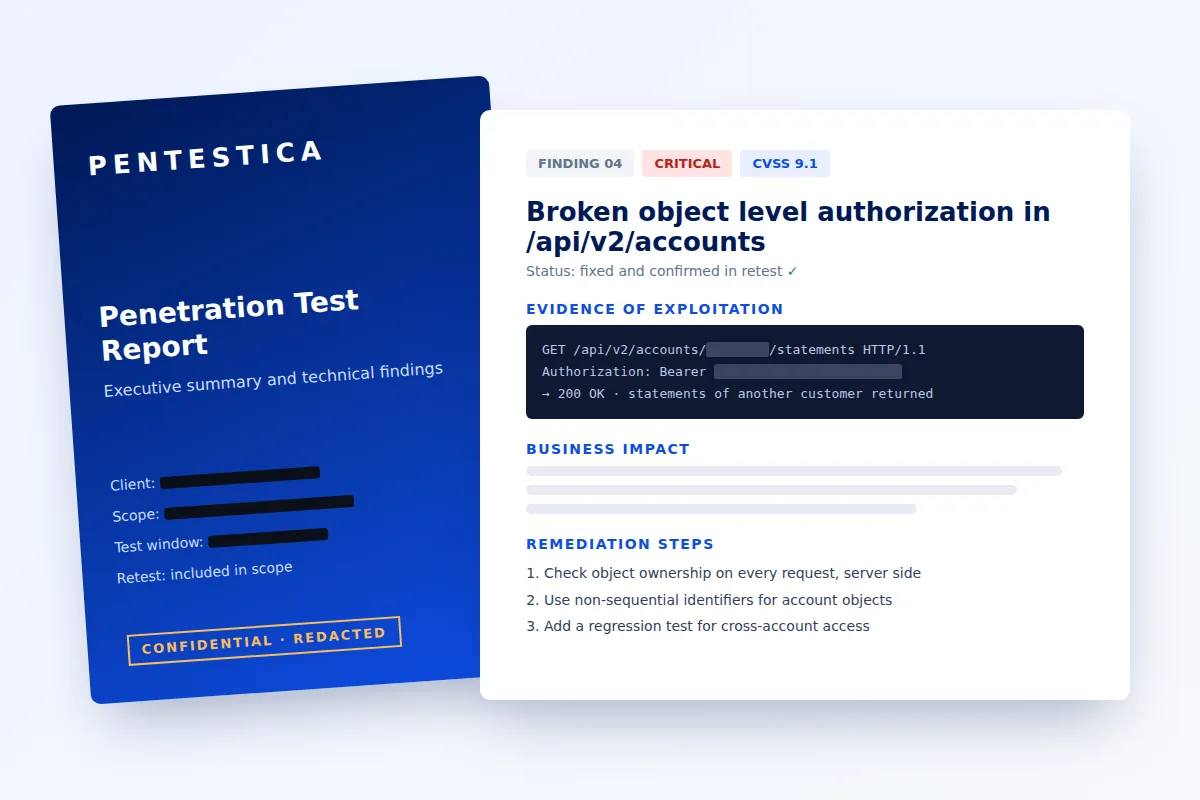
What does our report format look like?
Our reports have two layers: an executive summary for decision-makers, then technical detail your team can act on. See a sample penetration test report for the format. If the engagement includes a penetration test, a retest is available after fixes.
Who does the work?
Senior specialists from our team of 25 certified pentesters, whose certifications include OSCP, OSCE and CISSP, as well as CEH, CISA, CISM and CRISC.


Our case studies
How we tested a FinTech API, a medical SaaS platform and a retail web store: scope, findings, fixes and the retest.
Frequently asked questions
Do you certify compliance with ISO/IEC 27001, SOC 2 or NIS2?
No. Pentestica doesn’t certify compliance or issue SOC 2 reports. Our assessments and tests give your auditor or certification body evidence to review.
Do you offer incident response or digital forensics?
No. We don’t provide incident response, forensics, threat intelligence or 24/7 monitoring. We help you prepare, through tabletop exercises and penetration tests.
What's the difference between a vCISO and a cybersecurity consultant?
A consultant usually answers a defined question in a project, such as a risk assessment or an architecture review. A vCISO is an ongoing, part-time leadership role that owns the security roadmap over time.
Can consulting replace a penetration test?
No. Consulting tells you where risk is likely and what to change; a penetration test proves what an attacker can actually do. Our guide on how often to run a penetration test covers the testing side.
What do you need from us to prepare a quote?
The question you want answered, what’s in scope, the requirement behind the request and your deadline. If testing is involved, our guide to defining a penetration test scope helps you prepare.
Fixed-price quote
Request a cybersecurity consulting engagement
Tell us what to test. You get a written scope, the number of tester-days and a fixed price before any testing starts. No hidden fees.
See a sample report first (18-page PDF, no email required)
Consulting engagements are quoted individually, in tester-days after a scoping call. All prices
What happens after you send it
- Tell us what to test Send the question you need answered, the systems, teams or vendors in scope, any regulation or customer requirement behind it and your deadline.
- Get a written scope and price We reply by email with scoping questions or a fixed quote in tester-days.
- Assess, report, validate Timing depends on the scope agreed on the scoping call. Critical issues are reported during the engagement. A retest is available after fixes.
- OSCP, OSCE and CISSP certified testers
- 500+ penetration tests
- Advice ranked by real attack paths
- Executive summary and technical report